PULSENOVA
JOURNAL
EVERY ENTRY CARRIES ITS NUMBERS
Your website was up to date. It did not help.
On Tuesday two flaws turned up in the software that runs most of the web. Not in WordPress, underneath it. Swiss universities went offline and a canton took its own sites down. What happened, the one question to ask your hoster, and why our sites had nothing to fix.
0 PHP FILES · 2 CVES · 9.2 CVSS · 4 PATCHED BRANCHES
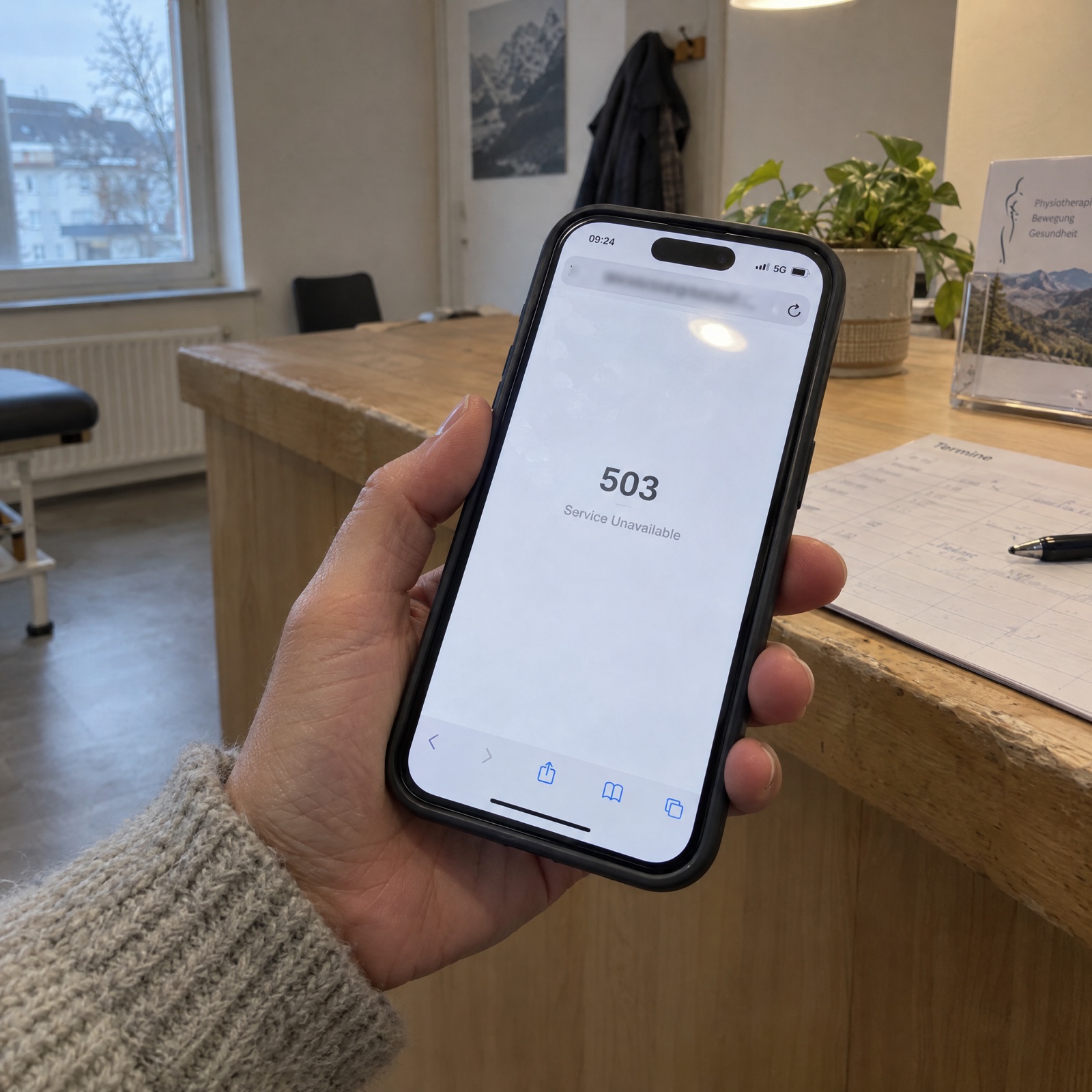
What happened on Tuesday
On 21 October an emergency update went out for a piece of software that sits under roughly seven out of ten websites. Two separate flaws. Both let a stranger run their own code on the server, without a password and without being logged in.
It was already being used before anyone announced it. Amazon recorded an attack attempt on 17 October, four days early. By the 21st it was several different groups. In Switzerland the websites of the University of Geneva and EPFL went dark. Several hosting companies took their own sites offline. The canton of Basel-Stadt pulled its cantonal websites as a precaution and says it has found no incident so far.
Germany's federal security office put out a warning at its second highest level. That is rare.
Why being up to date did not help
This is the part that surprised people, and it is worth two minutes.
There are two kinds of website. One puts each page together at the moment a visitor asks for it, out of a database, every single time. The other hands over a page that was already finished before anyone asked.
Almost every site of the first kind uses the same engine to do the assembling. WordPress uses it. So do Drupal, Joomla, Shopware and TYPO3. The flaw is in that engine. It is not in WordPress and not in your plugins.
That is why the usual advice did nothing here. Your updates were current, your theme was fine, your password was long. None of that is where the problem was. The engine starts handling a visitor before it has even looked at your settings. A site can be perfectly maintained and still be wide open.
What we found when we checked our own sites
We searched the code behind pulsenova.ch for files of the affected kind. There are none. Zero, in the whole project.
The reason is not cleverness, it is the kind of site we build. Our pages are finished minutes or weeks before a visitor arrives, by a process that is not connected to the internet. What a visitor requests is a finished file. Where another server would start up that engine, ours hands over a document. Become A Yogi works the same way. Zur Linde, FC Rotkreuz and the property sites sit on Webflow, which also serves finished files.
So nothing of ours needed patching this week. Not because we were quick, but because there was nothing of that kind running.
Let us be exact about what that claim covers. None of the sites we build and run today has that engine in the path a visitor takes. That is a sentence about how they are built. It is not a sentence about them being safe.
Where we are not safe
A finished-file website is not a safe website. Our exposure moved somewhere else, it did not disappear. Saying where is the only honest way to write the paragraph above.
The machines that build our pages run a lot of borrowed code, and they hold the keys that let them publish. Someone poisoning one of those borrowed pieces is our version of this week.
There is one small piece of our setup that does run on every visit. It picks the language and sends a few requests on. Every line in it is reachable from outside. It has four automated tests, which is four more than it had in August and still not many.
Our contact form sends to our mailing tool. In September we found that if one password was missing from the configuration, it forwarded messages without checking whether the sender was a bot. It had been doing that silently. We fixed it and wrote it down.
And our chat assistant answers in our name. We ran thirty test cases at it before it went live, ten of them deliberate attacks. One case still has no result recorded: the one that tries to talk it into confirming a price it never gave. That is an open item on our list, not an achievement.
This week we had nothing to patch. Three weeks ago we did.
The one thing to do today
Write to whoever hosts your website and ask two things. Which version of this engine serves our site. When was it last updated.
Ask in writing, and ask for the version number rather than a reassurance. If the answer takes more than a day, you have learned something either way.
For your hoster or your IT
The vulnerabilities are CVE-2026-109618 and CVE-2026-109619 in PHP, both rated 9.2 on CVSS 4.0 by the PHP security team, collectively called PHP2Shell. Patched in 8.5.12, 8.4.27, 8.3.36 and 8.2.35. For 7.4 through 8.1 there is no release, only source backports. 5.4 through 7.3 are end of life and get nothing. No particular configuration is required to be vulnerable. Restart all workers after patching. If patching has to wait, the partial mitigations are memory_limit at -1 without application override, session.upload_progress.enabled at 0, and on 8.5 fatal_error_backtraces at 0. Cloudflare has shipped WAF rules for known exploit paths to all customers and describes them as a stopgap. CERT-EU advises taking internet facing applications off the public network until a fix is in place and verified.
When moving off it is worth it, and when it is not
Not every website should be built the way ours are.
If your team changes content several times a day, or you run a real shop with stock and shipping, assembling pages on request is the right choice. Then keeping up with updates is simply part of the job, and a good hoster earns their fee doing it.
Most business websites are not that. A restaurant, a practice, a club, a hotel: the content changes weekly at most, and it gets read far more often than it gets written. For those, the finished-file approach gives your team the same place to log in and edit, and takes that engine out of the visitor's path completely. You still write a post and press publish. The pages get rebuilt. The finished files go out.
The trade, stated plainly: you give up assembling pages in real time, which you were not using, and you stop having Tuesdays like this one.
Working with us
If you spent yesterday patching, or waiting for someone else to, two things.
Send us your website. You get three decisions nobody ever made on it, in writing, within a week, including what it runs on now and what that means for you. No strings and no invoice.
If you want it off that engine, this is a move we have done repeatedly, most recently a sixty page practice website rebuilt in two days. One partner from strategy through launch, and the result belongs to you. It starts with a call, thirty minutes, free. What it costs depends on what it is, and we work that out together before anyone commits.
PULSENOVA
NEXT NOTE
60 PAGES · 23 COMMITS · 100 A11Y · 3.99 S MOBILE LCP
NEWSLETTER
One build note. Every week.
What shipped on a client site, what broke, and the fix that worked. Written from inside the studio, sent once a week. No pitch, no link roundup.
UNSUBSCRIBE FROM ANY EMAIL. STORED WITH KIT.